

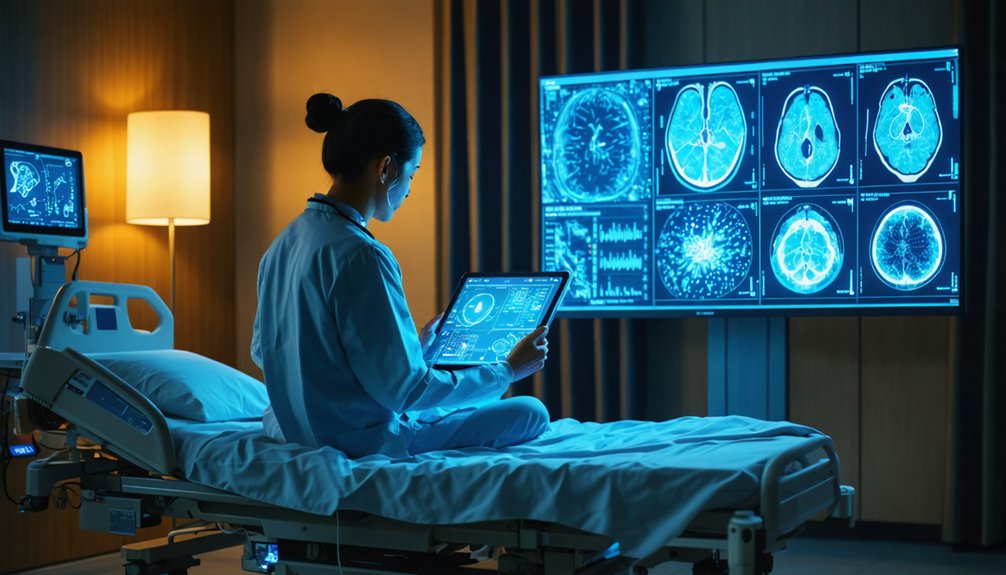

AI substantially enhances early diagnosis in healthcare by improving tumor detection accuracy and facilitating predictive analytics for early intervention. Advanced algorithms exhibit high precision, such as a 94% accuracy rate in tumor detection and 98.5% negative predictive value in breast cancer screenings. Predictive models identify high-risk patients before symptoms arise, enabling timely interventions and personalized care strategies. This revolutionary technology revolutionizes diagnosis practices and healthcare outcomes, encouraging further exploration of its potential benefits, and undergoes a profound change to become an essential tool, and this change greatly improves diagnosis practices.
Highlights
- AI algorithms achieve high accuracy in early cancer detection, with performance levels comparable to experienced radiologists, enhancing diagnostic precision.
- Predictive models identify high-risk patients before symptoms manifest, facilitating timely interventions and reducing healthcare complications.
- AI-powered tools streamline clinical documentation, allowing clinicians to focus more on patient care and improve overall workflow efficiency.
- Integration of AI with clinical decision support systems enhances data analysis, leading to improved diagnostic accuracy and earlier disease identification.
- AI reduces hospital admissions significantly by supporting proactive health management and enabling personalized prevention strategies for various non-communicable diseases.
Enhanced Accuracy in Tumor Detection
Enhanced accuracy in tumor detection represents a significant advancement in the integration of artificial intelligence (AI) within healthcare diagnostics. AI algorithms show outstanding performance, achieving a median positive predictive value of 36.9% and a negative predictive value of 98.5% in breast cancer screenings, paralleling expert radiologists. Notably, the top AI algorithms achieved performance levels comparable to the average screening radiologist, further solidifying AI’s role in enhancing diagnostic precision. Recent studies demonstrate that AI algorithms can detect tumors with a remarkable accuracy rate of 94%, greatly benefiting early cancer diagnosis. AOA Dx’s platform for ovarian cancer detection has demonstrated exceptional accuracy, outperforming traditional markers and showcasing the potential of AI-powered diagnostics.
These diagnostic innovations report accuracy rates as high as 94%, enhancing precision in imaging-based tumor detection. In ovarian cancer, AI outperformed traditional markers with an area under the curve of 92%, while exhibiting 100% detection rates in gastric cancer endoscopies. Such medical breakthroughs highlight AI’s ability to drastically improve early diagnosis, reducing false negatives and thereby offering hope for better patient outcomes.
Enhanced detection capabilities signify an unprecedented age in cancer diagnostics, nurturing a more inclusive approach to healthcare.
Predictive Analytics for Early Intervention
As healthcare increasingly adopts predictive analytics, the focus on early intervention has shifted dramatically, allowing for more proactive management of patient care. Predictive models such as the LACE Index and the HOSPITAL score enable early risk identification, accurately evaluating hospital readmission risks by analyzing crucial signs and patient history. This proactive approach helps prioritize high-risk patients for timely follow-ups and interventions, ultimately improving patient outcomes. Additionally, predictive analytics aids in the early detection of chronic diseases, facilitating prompt treatment that reduces complications and healthcare costs. By leveraging predictive models to identify at-risk patients, healthcare providers can implement tailored interventions that significantly decrease rates of readmission and improve overall care. Furthermore, utilizing data-driven models ensures that healthcare resources are allocated efficiently, maximizing the benefits of early intervention strategies. These predictive analytics not only improve patient engagement but also support operational decision-making, enabling organizations to better anticipate needs and allocate resources effectively.
Implementation Trends in Healthcare Systems
The integration of predictive analytics in healthcare has set the foundation for significant implementation trends, particularly in the adoption of AI technologies across healthcare systems.
Implementation strategies increasingly focus on AI-driven clinical documentation and workflow optimization, reducing administrative burdens on clinicians. Technologies like ambient listening and natural language processing automate tasks such as clinical note generation, enhancing documentation efficiency and accuracy. AI-powered tools support medical professionals by streamlining routine tasks, enabling them to devote more time to patient care. Furthermore, early adopters of AI have showcased its possibilities, with more organizations expected to follow in 2025. Automated documentation enhances the organization and connection of medical records, leading to improved efficiency in patient care.
Moreover, remote patient monitoring and wearable devices are becoming integral to chronic disease management, allowing real-time data analysis for proactive care.
As healthcare systems shift from pilot programs to widespread adoption, the emphasis on ethical considerations and regulatory compliance guarantees patient safety while promoting innovation.
These trends reflect a concerted effort to prioritize patient-centered care and efficiency within healthcare environments.
Impact on Healthcare Outcomes and Costs
AI’s integration into healthcare has substantially influenced both patient outcomes and cost efficiency. The accuracy of AI algorithms in tumor detection surpasses that of experienced radiologists, promoting earlier diagnosis and substantially improving five-year survival rates for conditions like lung cancer. Additionally, AI’s ability to predict stroke risk with remarkable precision enables timely interventions that save lives. Furthermore, a comprehensive bibliometric analysis emphasized that AI has transformative potential in early detection and risk assessment of non-communicable diseases (NCDs), reinforcing its broader impact on healthcare.
On the cost front, AI reduces hospital admissions by up to 50%, minimizing spending on complex care and enhancing resource management. By providing personalized interventions and real-time monitoring, AI promotes health equity, ensuring underserved populations receive timely care. Overall, the integration of AI not only enhances patient survival rates but also contributes to considerable cost savings within healthcare systems.
Reducing Diagnostic Errors and Bias
Integrating advanced technologies such as artificial intelligence into healthcare diagnostics is proving essential for reducing errors and bias in clinical decision-making. AI-driven Clinical Decision Support (CDS) systems enhance diagnostic innovations by automating data retrieval, thereby alleviating cognitive overload for clinicians.
These tools minimize intuitive “System 1” thinking and associated biases, such as confirmation bias, fostering a more analytical and data-driven environment. Machine learning models identify missed diagnostic opportunities, improving clinical effectiveness by flagging high-risk cases for further evaluation. Additionally, AI optimizes image acquisition and interpretation, ensuring exhaustive analyses that reduce human error.
Technological Evolution of AI Diagnostic Tools
As advancements in technology continue to reshape the terrain of healthcare, the evolution of AI diagnostic tools stands out as a vital change agent.
Over recent years, a significant focus has emerged within AI-powered diagnostic imaging, where algorithms increasingly outperform human experts in identifying conditions like pneumonia and breast cancer from imaging data.
Moreover, technological advancements in molecular diagnostics, particularly liquid biopsy tools, facilitate early cancer detection with enhanced precision.
The integration of AI with clinical decision support systems streamlines data analysis, enabling better treatment pathways.
Emerging technologies, such as quantum AI, promise to revolutionize the scenery further by analyzing extensive medical datasets swiftly, ultimately improving diagnostic accuracy and nurturing personalized medicine.
Future of AI in Early Disease Detection
The future of early disease detection is being reshaped by innovative AI methodologies that promise enhanced diagnostic capabilities and proactive health management. Continuous advancements in data analysis are allowing AI to integrate multi-modal data—from genomic profiles to imaging scans—leading to significant medical breakthroughs.
With predictive models achieving accuracies exceeding 94% in early cancer detection and over 90% in identifying neurodegenerative diseases, healthcare can shift from reactive to preventive strategies. As AI systems enhance risk stratification, identifying high-risk patients before symptoms manifest, the potential for timely interventions increases. By 2025, expanded AI tools are anticipated to improve population health monitoring, personalizing prevention strategies and ultimately revolutionizing the scenery of early disease detection for diverse patient populations, enabling healthcare professionals to take a plunge into more effective treatment plans and radically change the terrain of medical care.
Conclusion
To summarize, the integration of artificial intelligence in early diagnosis is revolutionizing healthcare by enhancing accuracy in tumor detection, leveraging predictive analytics for timely interventions, and developing through advanced technological tools. As healthcare systems increasingly adopt these innovations, they demonstrate potential for improved patient outcomes, reduced diagnostic errors, and cost efficiencies. The path of AI in early disease detection suggests a promising future where diagnostic processes become more reliable, ultimately reshaping the medical scenery of healthcare delivery.
References
- https://www.proventionhealth.org/how-artificial-intelligence-is-transforming-early-diagnosis-and-chronic-illness-care-in-2025/
- https://globalrph.com/2025/04/how-ai-achieves-94-accuracy-in-early-disease-detection-new-research-findings/
- https://pmc.ncbi.nlm.nih.gov/articles/PMC12049965/
- https://www.dialoghealth.com/post/ai-healthcare-statistics
- https://litslink.com/blog/ai-in-healthcare-breaking-down-statistics-and-trends
- https://www.contemporaryobgyn.net/view/top-ai-models-show-high-accuracy-in-breast-cancer-screening
- https://aoadx.com/aacr2025/
- https://www.nature.com/articles/s41591-024-03408-6
- https://pmc.ncbi.nlm.nih.gov/articles/PMC12025054/
- https://www.mghihp.edu/news-and-more/opinions/data-analytics/data-decisions-leveraging-predictive-analytics-transform-hospital-readmissions